Industrial TFT Backlight Lifetime and Dimming
The backlight is one of the most important lifetime factors in an industrial TFT display. It controls readability, power draw, heat, dimming behavior, and long-term brightness stability. A display can have a strong LCD cell and reliable touch panel, but if the backlight fades too quickly or runs too hot, the finished product will still create field complaints.
Industrial products often run for long shifts, sometimes continuously. They may sit in sealed cabinets, vehicle cabins, outdoor kiosks, solar inverter monitoring equipment, medical equipment, or factory HMIs. Backlight planning should start early, not after the enclosure and power supply are already fixed.
What backlight lifetime means
Backlight lifetime is usually stated as the time until brightness falls to a percentage of the original level, often 50 percent. A 50,000-hour rating does not mean the display suddenly fails at that hour. It means the display may be much dimmer than when it was new.
This matters because a product that is readable on day one may become marginal after years of use. If the display starts with little brightness margin, normal aging can push it below what operators need.
Brightness is not free
Higher brightness helps in sunlight, bright factories, and public terminals, but it costs power and heat. More LED current usually means more thermal stress. Heat can reduce LED lifetime and affect nearby electronics, adhesives, polarizers, touch sensors, and enclosure materials.
For outdoor products, high brightness should be paired with optical improvements such as anti-glare cover glass or optical bonding. A well-designed optical stack may improve readability without simply increasing backlight current. This is why sunlight readable TFT design should treat brightness, reflection, and thermal behavior together.
Temperature and derating
Backlight lifetime ratings are often based on defined test conditions. Real products may run hotter. A sealed cabinet in summer, a kiosk in direct sun, or a vehicle dashboard behind glass can raise display temperature significantly.
Ask suppliers for lifetime conditions and derating guidance. If the display is rated at room temperature but used near its upper temperature limit, actual life may be shorter. Thermal measurement in the final enclosure is essential.
PWM dimming
Pulse-width modulation, or PWM, is a common way to control backlight brightness. It switches the backlight on and off quickly, changing the duty cycle to change perceived brightness. PWM is efficient and widely used, but frequency and implementation matter.
Low PWM frequency can cause visible flicker or camera banding. Some users are sensitive to flicker, especially during long shifts. For industrial HMIs, choose a dimming method and frequency that avoid visible discomfort. Test at low brightness, not only at full brightness.
Analog dimming and hybrid control
Some designs use analog current control, PWM, or a hybrid approach. Analog dimming can reduce flicker but may affect color or efficiency depending on the LED driver. Hybrid dimming may use analog control over part of the range and PWM elsewhere.
The best choice depends on the application. A medical device, control room panel, or vehicle display may need very smooth low-light behavior. A simple outdoor terminal may prioritize maximum daylight brightness and thermal protection.
Automatic brightness control
Ambient light sensors can extend backlight life and improve comfort. The display can brighten in daylight and dim at night or during idle periods. This is especially useful in transportation, outdoor kiosks, and equipment used across changing shifts.
The control curve should be tested with users. If the display changes brightness too aggressively, it can feel distracting. If it responds too slowly, users may complain when moving between light conditions. Manual override is often useful for service and special cases.
UI design affects backlight needs
A high-contrast UI can reduce the need for extreme brightness. Thin gray text, pale icons, and low-contrast backgrounds may look modern on a design monitor but fail in real industrial light. Larger text, strong contrast, and clear alarm colors improve readability without always increasing backlight power.
Night mode can also help. A dark or dimmed interface reduces glare in vehicle cabins and control rooms. However, dark themes outdoors may reflect more depending on cover glass and ambient light. Test both modes in real conditions.
Power budget
In battery-powered devices, the backlight is often the largest display-related power draw. A small product can miss its battery target if the display stays bright during idle periods. Use timeouts, wake behavior, adaptive brightness, and clear power states.
For line-powered equipment, power still matters because it becomes heat. Extra heat can reduce reliability and make sealed enclosures harder to design. Backlight decisions should be included in thermal reviews.
Validation tests
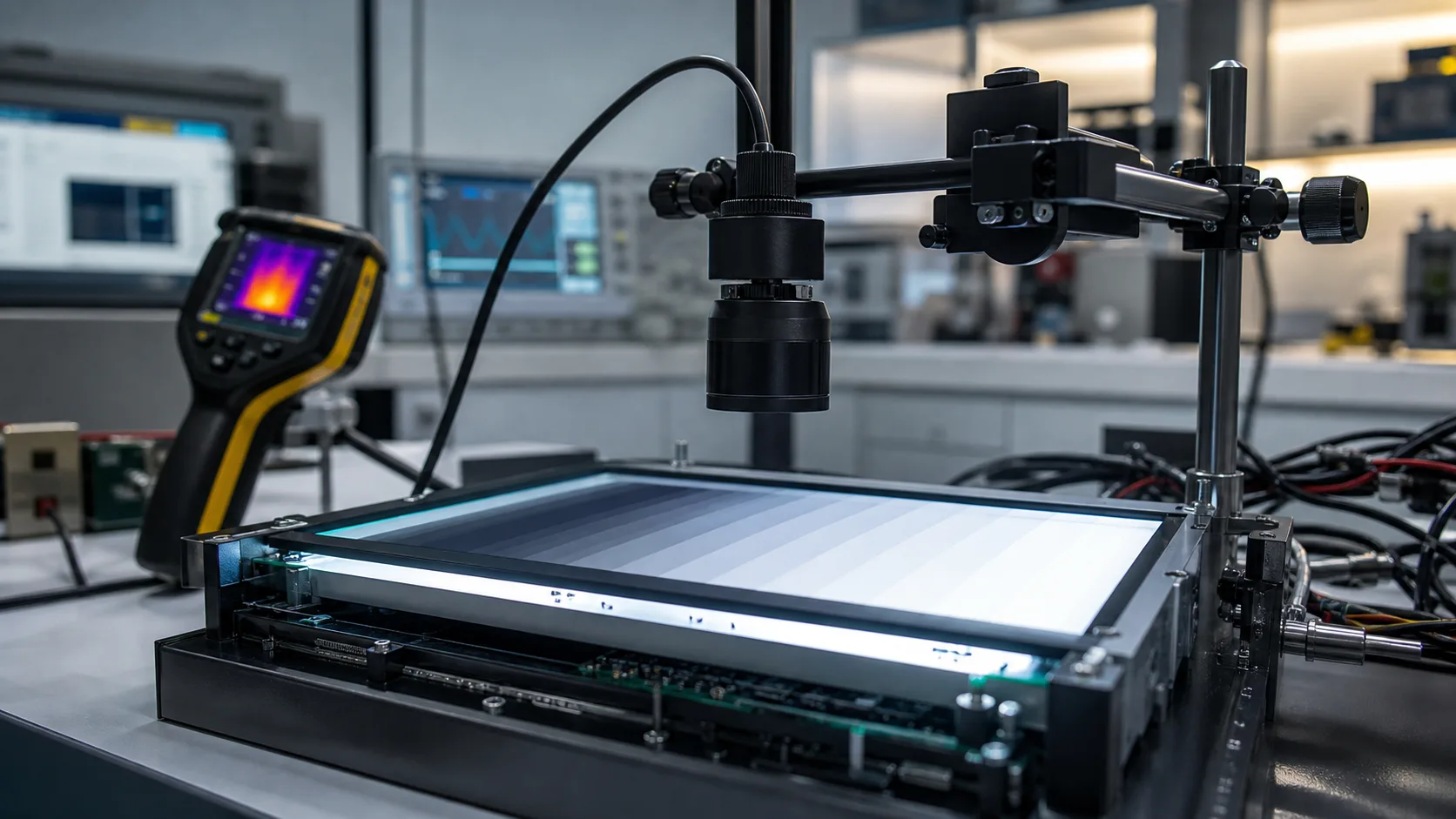
Test brightness at startup, after warm-up, at high and low temperature, at different dimming levels, and with the final cover glass. Measure surface temperature and internal enclosure temperature during long operation. If the product uses automatic dimming, test the sensor response under realistic lighting transitions.
For critical products, keep brightness measurements from early samples. They provide a baseline for production and field returns. A display that appears dim can then be compared against measured expectations rather than judged only by opinion.
Supplier questions
Ask about LED lifetime definition, test temperature, maximum current, recommended operating current, PWM frequency limits, driver options, optical bonding compatibility, and backlight replacement policy. Also ask whether the same LED bin and backlight structure will remain stable across future production.
These details show whether the display is being treated as a long-life industrial component or just a generic screen added late in the design.
Field maintenance signals
Backlight problems often appear gradually. Operators may not report that a display is aging until it becomes difficult to read in bright light. Service teams should know what a normal display looks like and what brightness level is expected after warm-up. If possible, include a simple brightness or backlight setting page in the service menu.
When a display is replaced, record runtime, brightness setting, installation temperature, and failure symptom. This information helps separate normal aging from thermal stress, driver problems, or a poor optical stack. Over time, these records can improve future display specifications.
For fleet products, compare units from different production batches under the same settings. If new units and older units look very different, users may think one of them is defective even when both technically pass. Consistent dimming curves and documented brightness targets make service discussions easier.
FAQ
What is a good backlight lifetime for industrial TFT displays?
Many industrial displays target tens of thousands of hours, but the useful life depends on brightness setting, temperature, and readability requirements.
Does dimming extend backlight life?
Usually yes. Lower average LED current reduces heat and aging, especially when combined with good thermal design.
Is PWM dimming bad for industrial HMIs?
Not necessarily. PWM is common, but frequency and implementation should be tested to avoid visible flicker or user discomfort.