Industrial TFT vs Consumer LCD: What You Actually Need to Specify
A consumer LCD can look excellent in an industrial prototype. The difficult questions arrive later: will it start in an unheated cabinet, remain readable after years of operation, and still be available when the next production order is placed?
The phrase industrial TFT vs consumer LCD is slightly misleading. TFT describes the active-matrix technology used in many LCDs, including consumer products. “Industrial” describes the intended application and the supplier’s commitments. It is not a universal certification, temperature range, or guarantee of reliability.
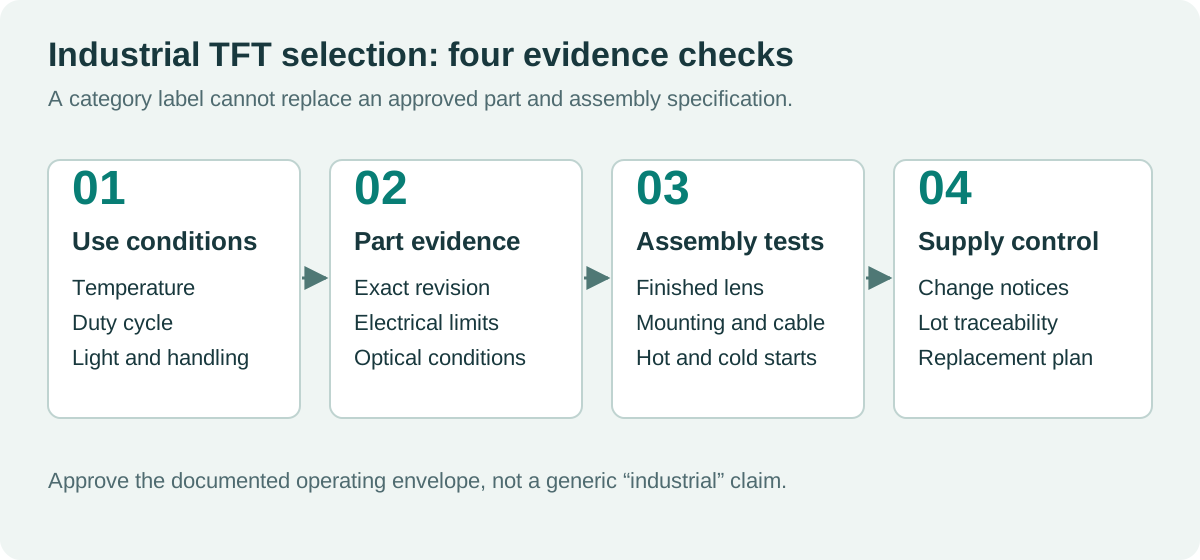
Select the module against a written operating envelope, then check whether the supplier can support that envelope. Paying for an industrial label without collecting the evidence leaves the main risks unresolved.
Compare commitments, not labels
Start with the conditions inside the finished product. The temperature near the LCD may be much higher than the room temperature, particularly behind a sealed front lens. A panel that is adequate on an open bench can be outside its rating once the processor, power supply, and backlight share an enclosure.
| Decision | Evidence to request | What a marketing label cannot tell you |
|---|---|---|
| Temperature | Operating and storage limits, test conditions, cold-start behavior | Whether graphics remain readable at the low limit |
| Continuous use | Backlight degradation definition, current, and temperature | How bright the installed display will be after several years |
| Optics | Minimum luminance and viewing-angle test method | Readability through your cover glass |
| Mechanical fit | Controlled drawing, tolerances, connector and FPC details | Whether a replacement will fit the same opening |
| Supply | Product status, change notice process, end-of-life terms | Guaranteed availability for the product’s service life |
| Quality | Agreed visual criteria and lot traceability | What counts as an acceptable pixel or uniformity defect |
For example, Kyocera’s industrial TFT product range includes wide-temperature and long-backlight-life options, but its overview directs buyers to individual part specifications. A range maximum is not a specification for every panel in that range. Record the exact part number and revision used in the design review.
Our industrial LCD specification checklist provides a useful starting point for that review. Add the conditions that are specific to your machine rather than copying a generic operating range.
Turn the use case into a qualification envelope
Consider two products with the same 7-inch screen. A diagnostic instrument used indoors for a few hours each week may be well served by an ordinary commercial module. A pump controller installed outdoors and operated continuously creates a different problem, even if both products show only a few numeric values.
Write down the expected duty cycle, sunlight exposure, enclosure temperature, cleaning chemicals, vibration, and maintenance access. Separate normal operation from transport and storage. A storage-temperature rating does not establish that the LCD will update correctly at that temperature while powered.
Also distinguish survival from usable performance. At low temperature, a display can remain electrically functional while transitions become too slow for an operator task. At high temperature, the assembly may develop optical artifacts or exceed backlight thermal limits before the host computer reports a fault. Validate the actual screen content at both ends of the envelope.
Backlight life needs an operating condition
“50,000 hours” is incomplete unless the supplier states what changes at that point and under which conditions. Is it a typical time to a defined luminance level? At what LED current and temperature? Does the value apply to the backlight, the LCD module, or a complete monitor?
As a planning example, continuous operation for five years is about 43,800 hours. That arithmetic helps frame a question; it does not prove a display will meet a five-year brightness requirement. Temperature history, dimming strategy, and the definition of end of life still matter.
Specify the minimum acceptable installed luminance at the maintenance interval. Include losses through the touch sensor and cover lens. If the requirement only states initial panel brightness, a supplier can meet it while the finished product misses the operator’s needs later. The relationship between drive current, temperature, and degradation is discussed further in our TFT backlight lifetime and dimming notes.
An industrial panel is not a sealed HMI
A bare LCD module usually relies on the product enclosure for ingress protection, mechanical support, and user access protection. Its metal frame does not establish an IP rating for the assembled HMI. Nor does a wide-temperature LCD automatically give the touch sensor, adhesive, or controller board the same rating.
Review the complete stack: cover glass, touch sensor, bonding material or air gap, LCD, mounting frame, seals, electronics, and cable exits. Confirm that the supplier’s tests apply to the same configuration being purchased. A report for a bonded module cannot automatically qualify a different adhesive or thicker cover lens.
For the optical decision, compare industrial display optical bonding with a well-designed air gap. Bonding can improve the assembly, but it also changes repair options and introduces process-control requirements.
Supply continuity is an engineering requirement
Ask what happens when the LCD driver, LED package, polarizer, or FPC supplier changes. A module may retain its sales name while a revision changes timing, current consumption, appearance, or software initialization. The purchase agreement should define which changes require notification and which require approval.
A longevity program for one component does not cover the entire display assembly. ST’s product longevity program, for instance, applies to listed semiconductor products under defined terms. It is an example of the specificity to look for, not evidence that a display using an ST device will remain available for the same period.
Keep a replacement package with the mechanical drawing, pinout, voltage rails, timings, optical limits, firmware configuration, and approved sample photographs. A nominally identical diagonal and resolution are not enough to make two panels interchangeable.
When a commercial module is a reasonable choice
There is no engineering benefit in rejecting a well-documented commercial module solely because of its market category. The important question is whether its limits and support model fit the product.
| Product situation | Sensible selection approach |
|---|---|
| Indoor, intermittent operation, short production run | Evaluate commercial and industrial modules against the same requirements |
| Long production life with expensive redesign | Give change control and replacement compatibility substantial weight |
| Unheated outdoor cabinet | Qualify cold start, hot enclosure operation, moisture, and finished-stack readability |
| Equipment serviced by swapping the whole monitor | Compare complete monitor support and mounting compatibility |
| Custom embedded assembly with bonded touch | Qualify the bonding process and assembly supplier as well as the panel |
Price the integration work too. A cheaper module can be economical when its documentation is complete and the design has margin. It becomes less attractive when every shipment needs investigation or the controller must be redesigned halfway through production.
What should the approval package contain?
Before releasing the design, assemble a signed specification, the approved module revision, qualification results, an incoming inspection plan, and the supplier’s change-notification terms. Record exceptions explicitly. “Acceptable for indoor use only” is useful; an unexplained approval tick is not.
Use the same application image for sample comparisons. Include dark areas, small text, a gray ramp, and the most important alarm state. Test it through the final cover lens, at the intended viewing distance, with the production backlight setting. Keep photos for identification, but use instruments for luminance measurements.
The final decision should be easy to explain: this module meets these conditions, with this remaining margin, and this replacement plan. That is a much stronger basis for an industrial product than a category name on a quotation.
Sources and photograph
Technical sources are linked beside the relevant claims. The examples and selection workflow are engineering guidance, not qualification results for the photographed product.
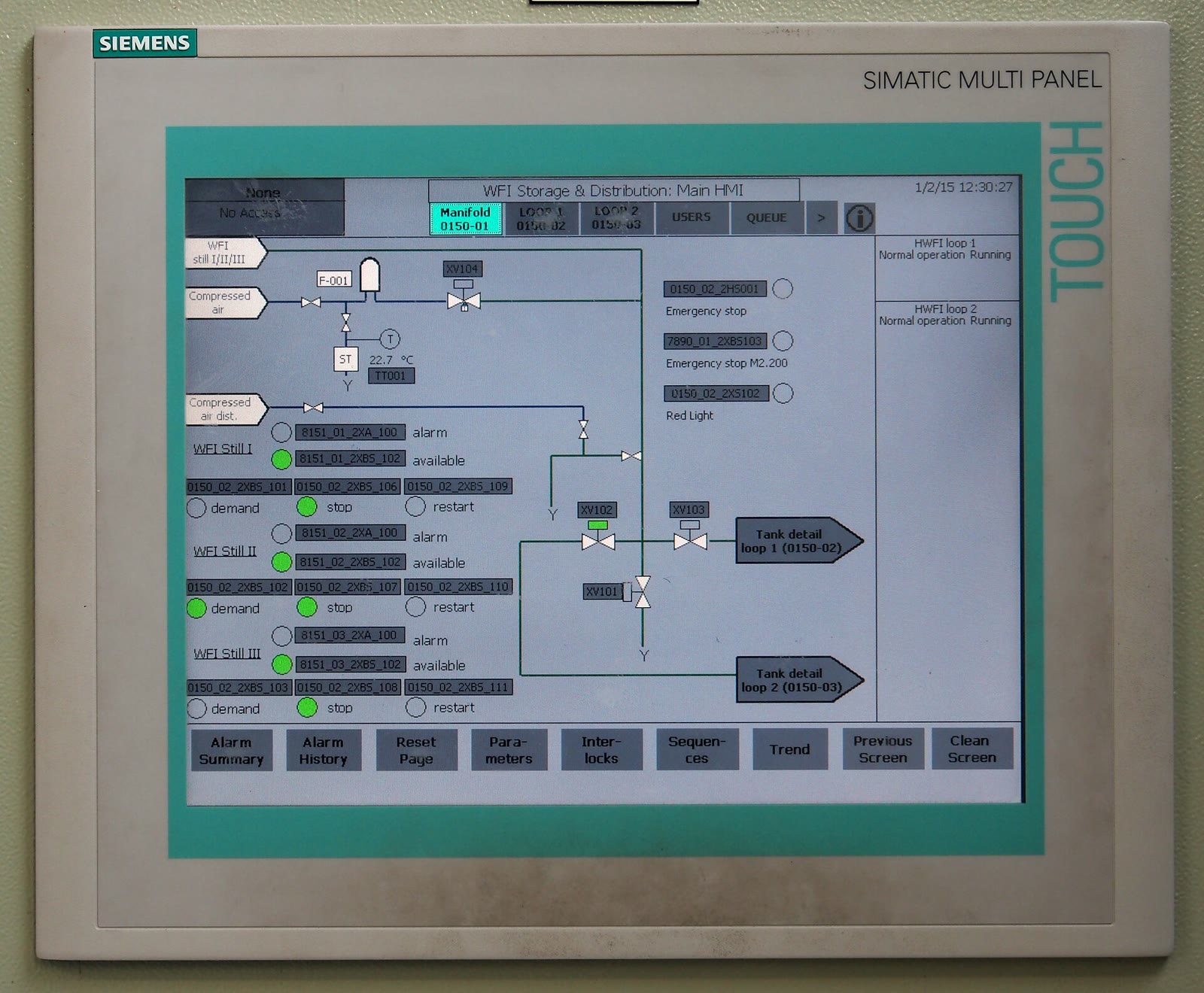
Hero photograph: Alf van Beem, Siemens SIMATIC Multi Panel, dedicated to the public domain under CC0 1.0. Resized and JPEG-compressed for this page. The selection diagram is an original explanatory illustration.