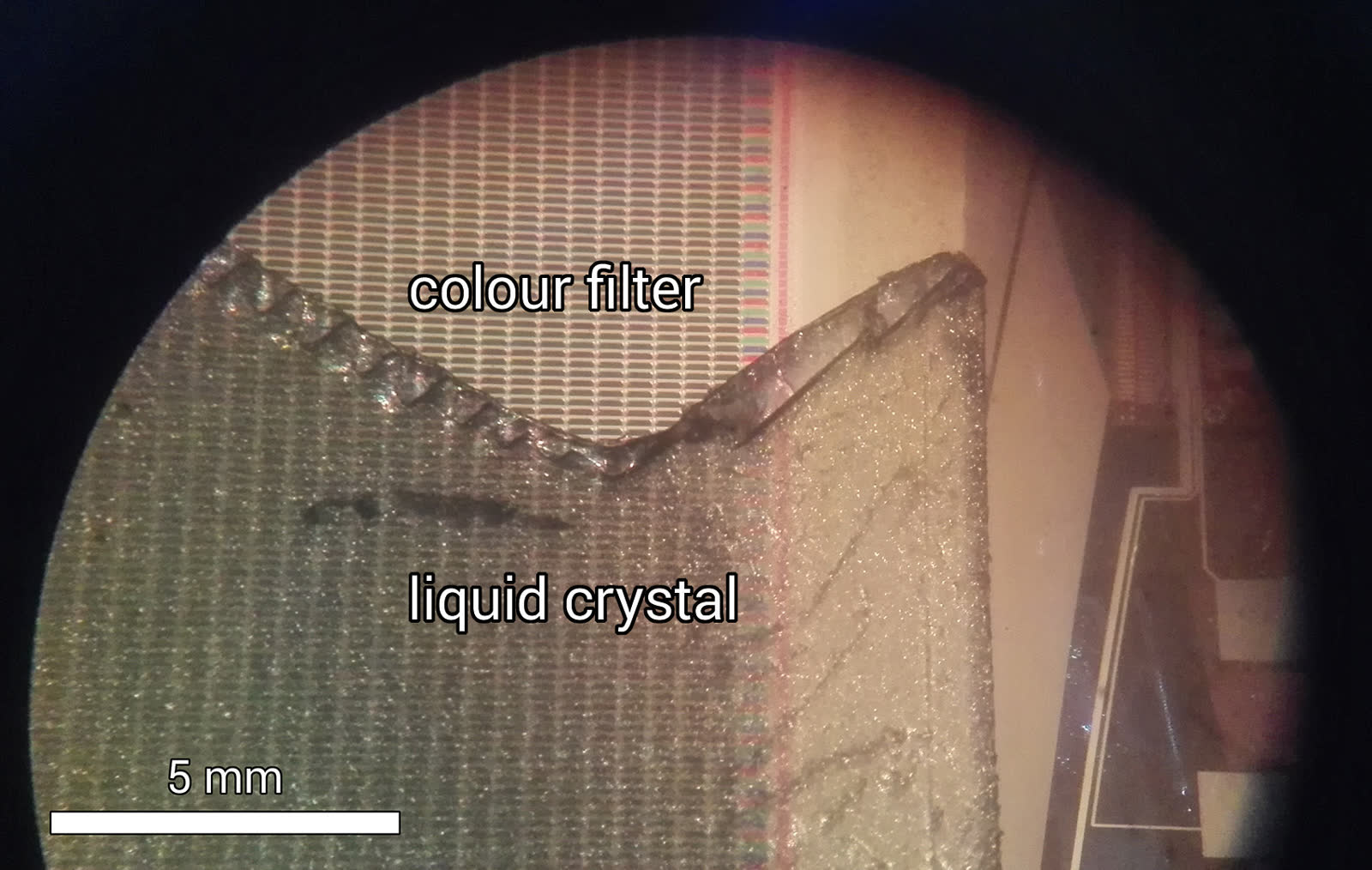
TFT Dead Pixel Policies: Bright, Dark, and Cluster Defects

A bright point on a black screen and a dark point on a white screen are not the same defect. Neither is automatically a complete pixel failure. Before accepting a TFT shipment, define what is counted, where it is counted, and under which viewing conditions.
A workable TFT dead pixel policy connects the supplier’s visual criteria with the product’s actual display tasks. It should also distinguish receiving acceptance from warranty coverage. Those agreements can have different limits and time periods.
Start with pixels and subpixels
A conventional RGB pixel contains red, green, and blue subpixels. A defect can affect one subpixel, several within a pixel, or a larger region. Terminology varies, so the agreement should include explicit definitions.
A bright defect is assessed on a dark test image; a dark defect is assessed on a light image under the specified method. A colored point on white can indicate that only part of the pixel is affected.
| Defect description | Typical inspection image | Definition to agree |
|---|---|---|
| Bright subpixel | Black | Which emitted points count and at what visibility |
| Dark subpixel | White or primary colors | How partial pixel failures are classified |
| Full pixel defect | Multiple patterns | Whether several failed subpixels count separately |
| Cluster | Defined pattern set | Distance rule and permitted grouping |
| Line defect | Full-field patterns | Separate rejection category |
| Contamination | Powered and unpowered inspection | Separation from electrical pixel defects |
Do not infer the transistor failure mechanism solely from the appearance. The acceptance task is to classify the visible result reproducibly.
Manufacturer policy is not a universal rule
EIZO’s warranty information illustrates that a manufacturer’s bright-pixel and dark-pixel terms can be defined separately. Such a policy applies to the covered products and conditions; it is not a default acceptance standard for every bare TFT module.
Ask the module supplier which policy applies to the quoted part and whether a referenced standard is incorporated into the contract. A standard number without an agreed class, edition, and interpretation can leave substantial ambiguity.
Place the final criteria in the industrial LCD acceptance specification. The supplier and buyer should approve the same definition before the first production lot.
Define the viewing method
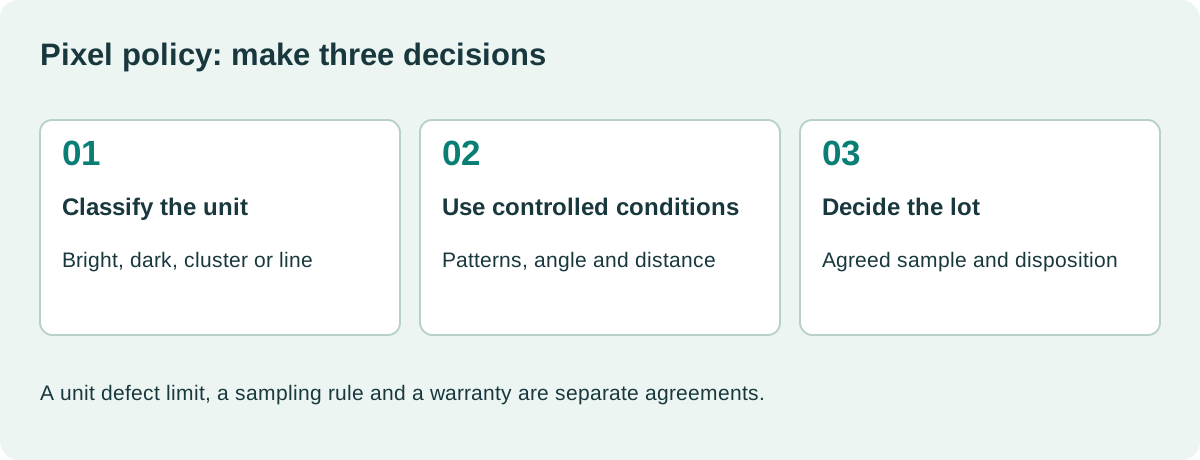
Specify ambient lighting, backlight setting, stabilization time, viewing distance, angle, and test patterns. A point invisible under one setup may be conspicuous under another.
Clean the surface using the approved method before concluding that a speck is a pixel defect. EIZO’s monitor-test guidance notes that dust can be confused with defective pixels. Preserve evidence before cleaning if contamination itself is part of the complaint.
Use native-resolution solid colors and disable unrelated overlays. Scaling a test pattern can complicate classification. Record whether inspection uses an unassisted eye, magnification, or both.
Magnification can help identify subpixels, but it should not silently change the agreed visibility criterion. A manufacturing diagnostic and a user-visible acceptance test answer different questions.
Clusters need a geometric definition
“Two defects close together” is incomplete. Define whether distance is measured center-to-center, how the inspection region is constructed, and whether mixed bright and dark defects form a cluster.
Use a pixel-coordinate map for disputed samples. Record the full panel resolution and orientation so the same location can be found again. For a rotated application, retain the relationship between panel coordinates and displayed coordinates.
A small cluster can be more distracting than the same number of isolated points. The policy should therefore state both total counts and grouping rules if both matter.
Avoid inventing an arbitrary cluster radius after observing a failure. That makes the decision difficult to defend and difficult for the supplier to reproduce.
Consider the application without hiding defects
A static bright point beside a routine status icon may be less consequential than one within a critical measurement trace. If the product needs stricter regions, define them before purchase.
Zone maps need clear coordinates and should not rely on an application screenshot that can change with firmware. State which hardware area is critical and how its criteria differ.
Do not “repair” acceptance by moving text over a defect unless that is an explicitly approved product concession. The defect remains in the supplied hardware and may appear in another page or service mode.
For instruments, the measurement display rendering review explains why trace interpretation and data presentation deserve special attention.
Separate pixel defects from uniformity and damage
Mura, pressure marks, scratches, contamination, backlight leakage, and damaged rows or columns need their own categories. A pixel-count allowance should not become a catch-all for unrelated optical problems.
Inspect several gray levels as well as primary colors. If a mark changes with frame pressure or cable position, retain that observation for engineering investigation.
| Observation | Useful next check |
|---|---|
| Point visible on black only | Bright-defect classification |
| Point visible on white only | Dark-defect classification |
| Mark persists unpowered | Surface contamination or physical damage |
| Broad patch changes with load | Mounting pressure and uniformity |
| Entire line affected | Row/column path and separate rejection rule |
| Defect appears intermittently | Timing, connection, temperature and repeatability |
A receiving inspector should have a clear escalation path for defects outside the written categories.
Connect the policy to lot sampling
The visual limit defines whether a tested unit conforms. The sampling plan defines how inspected results determine the disposition of a lot. Do not mix those two decisions.
The TFT incoming inspection workflow covers traceability, fixture control, and lot release. Retain inspected-unit identity and the specific pattern used for each defect.
A sample passing inspection does not prove every unit is defect-free. Similarly, a warranty promising replacement under defined conditions is not evidence that incoming criteria can be left unspecified.
Document concessions and replacements
When accepting a nonconforming lot under concession, record quantity, defect details, affected product use, approval, and any special marking. Keep that stock distinguishable from normally accepted inventory.
If a field return is disputed, reproduce the agreed conditions and compare with the original record. Camera exposure and compression can exaggerate or hide points, so photographs support identification rather than replace the specified inspection.
For a second-source TFT qualification, align visual policies before comparing prices. A cheaper panel with looser cluster acceptance is not an equivalent commercial offer.
What does a complete policy look like?
It contains defect definitions, numeric limits, cluster and zone rules, test conditions, lot decision rules, warranty scope, and a dispute procedure. Include examples where language alone could be interpreted differently.
That agreement gives inspectors a repeatable decision and gives the engineering team a clear basis for selecting a panel suitable for the product. It is more useful than a broad claim that a display is “zero defect” without saying what that phrase covers.
A practical handover detail
For a disputed point, capture its coordinates and appearance on black, white, and the three primary-color patterns before making a classification decision. Keep the panel at the same orientation and record whether the point is continuously visible. A single compressed photograph can obscure which subpixel is affected. Where the contract uses an observer judgment, repeat that judgment under the agreed conditions rather than substituting a magnified image taken under unrelated lighting. The evidence should reproduce the acceptance method, not redefine it.
Sources and image credit
Primary technical references are linked beside the relevant claims. Numerical examples are calculations under the stated assumptions. The original diagram explains the design method; neither it nor the photograph represents a qualification test performed by this site.
Hero photograph: ALexL33, CC BY-SA 3.0. Resized and JPEG-compressed; cropped from the source photo composite. This adapted photograph remains under the linked ShareAlike license.